

In this article.
- Why Does Anxiety Keep Coming Back After You Calm Down?
- Why This Distinction Matters
- Why Calming Helps, But May Not Be Enough
- What Does Calming Down Actually Mean?
- What Does Retraining Anxiety Mean?
- Why Anxiety Can Keep Coming Back
- Relief Is Not the Same as Recovery
- In My Clinical Experience, This Is Where People Get Stuck
- What This Does Not Mean
- The Reframe: Calm Is a Foundation, Not the Finish Line
- What Helps Anxiety Change Over Time?
- Calming Anxiety vs Retraining the Response
- A Simple Way to Use Calming Differently
- In Summary
- How Solution Focused Hypnotherapy May Support This Process
- An Evidence-Informed Perspective
- Frequently Asked Questions
- Related Reading and Next Steps
- A Calm Next Step
You breathe. You ground yourself. You try to relax your body, slow your thoughts, soften your shoulders, and remind yourself that you are safe.
And sometimes it works. The anxiety comes down your body settles and you feel a little more like yourself again. But then, later, it returns - the same feeling, the same dread, the same checking. The same need to calm yourself before you can carry on.
That is one of the most frustrating parts of anxiety. You may be doing many of the “right” things like breathing, grounding, relaxation, meditation, vagus nerve exercises, hypnosis, or reassuring self-talk yet still feel as though anxiety keeps finding its way back in.
This doesn’t mean calming techniques are pointless. They can be genuinely helpful. But calming down is not always the same as helping anxiety change.
Why Does Anxiety Keep Coming Back After You Calm Down?
Calming techniques can help reduce anxiety in the moment by settling the body and lowering arousal. But if anxiety keeps returning, your brain may also need opportunities to learn a different response over time.
Longer term change often involves not only calming the nervous system, but also changing how you interpret anxiety, reducing patterns such as excessive checking, avoidance, or reassurance-seeking, and taking small, manageable steps that show the brain anxiety does not have to decide what happens next. That distinction matters. Calming changes how you feel right now. Retraining changes what your brain learns to do next time.
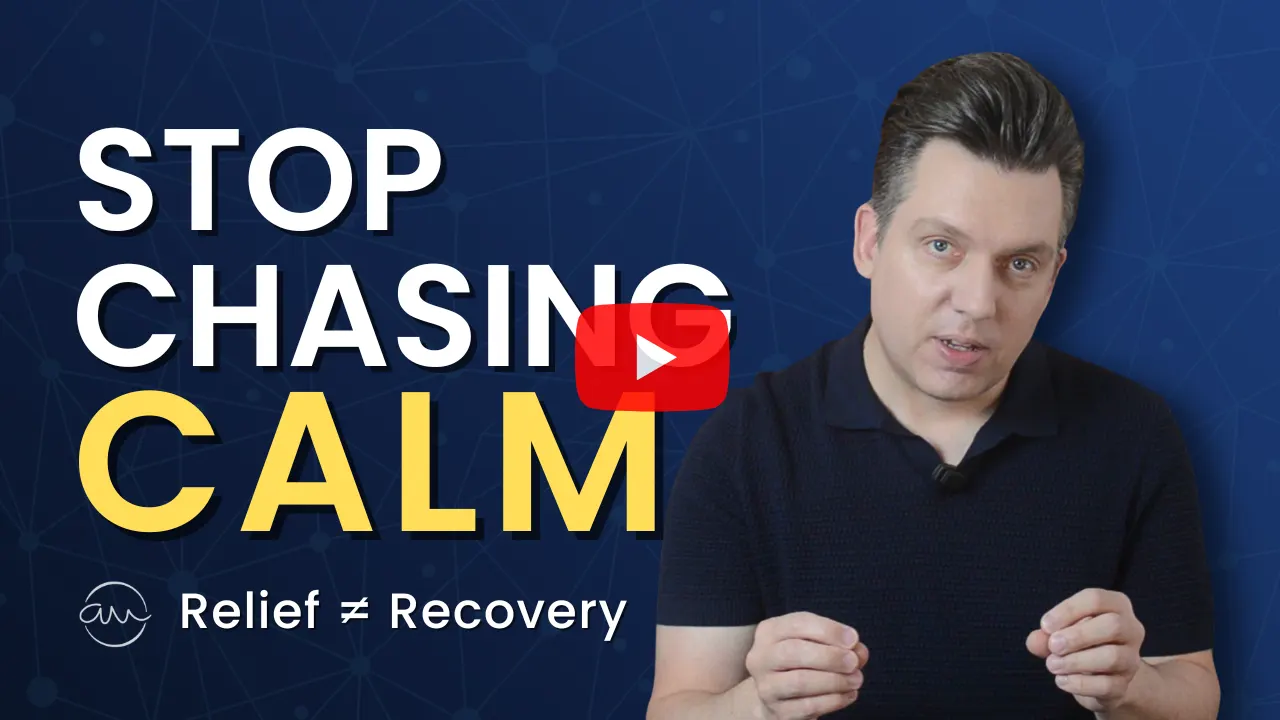
Prefer to watch? In this video, I explain why anxiety can keep returning even when calming techniques help, and what can support a different response over time.
Why This Distinction Matters
Many people arrive at this point feeling confused or discouraged. They are not ignoring the advice. They are not doing nothing. They may be trying very hard to manage anxiety.
They breathe. They practise mindfulness. They use grounding techniques. They read about the nervous system. They try to calm the body. And still, the pattern returns.
The problem isn’t always a lack of calming tools. Sometimes the deeper issue is that the response to anxiety has become organised around relief. The anxious feeling appears, and the whole system starts asking; How do I make this stop?
That is understandable because anxiety can feel urgent. But it may not be the only question that matters to you. A more useful question can be; what is my brain learning from the way I respond to anxiety?
Why Calming Helps, But May Not Be Enough
When anxiety rises, it is natural to want relief. The body can feel activated. Your heart may beat faster. Your breathing may change. You may feel shaky, dizzy, tense, unable to concentrate, or driven by an urge to escape, check, fix, solve, avoid, or seek reassurance.
The NHS describes a range of physical and psychological symptoms associated with anxiety and panic, including a racing heartbeat, trembling, dizziness, fast breathing, nausea, and difficulty coping with everyday life. You can read the NHS guidance on anxiety, fear and panic for further information.
In that moment, calming can be useful. Slow breathing, grounding, relaxation, guided hypnosis, and other regulation tools may help you feel steadier and create space between the feeling and your next response.
So this isn’t an argument against calming or an argument for understanding what calming is actually doing.
Calming can help change your immediate state. It can help you feel steadier and more present. It can give you more space to think clearly and help you pause rather than react automatically. But anxiety can also involve learned patterns of attention, interpretation, and behaviour.
A helpful way to think about this is that your brain is learning from experience:
Is this safe?
What happened last time?
What should I pay attention to?
What helped me get through this?
What should I do next time?
And this is where many people get stuck.
They calm the body, but the wider anxiety pattern remains because the deeper message is still:
I can only cope once this feeling has gone.
What Does Calming Down Actually Mean?
Calming down usually means reducing the immediate level of emotional or physical arousal. So, that might include breathing more slowly, relaxing tense muscles, grounding your attention, listening to hypnosis, stepping outside, taking a pause, or using a familiar routine to feel steadier.
There is nothing wrong with that, because learning how to settle your body can be a useful part of emotional wellbeing. But calming can become limited when it is treated as the whole solution.
If the only aim becomes, “I must get rid of this feeling,” anxiety can accidentally become the thing that has to disappear before life can continue. You may begin waiting to feel calm before making the call, having the conversation, going to the place, sending the message, making the decision, or allowing yourself to rest.
And, over time, the pattern can become:
I can only do this if I feel calm first.
That can make calm feel less like support and more like a condition.
What Does Retraining Anxiety Mean?
Retraining anxiety means giving your brain and body opportunities to practise a different response when anxiety appears. It doesn’t mean pretending you are calm when you are not. It doesn’t mean pushing yourself into overwhelming situations. And it doesn’t mean ignoring genuine risk, important emotions, or medical symptoms that need appropriate attention.
It means creating repeated, manageable experiences where something different happens. For example:
I can feel anxious and still take one small step.
I can notice a familiar sensation without immediately treating it as danger.
I can delay checking.
I can reduce reassurance-seeking.
I can allow some uncertainty to be present.
I can calm my body, then move forward rather than waiting for perfect calm.
This is where change can begin to move beyond short-term relief.
Why Anxiety Can Keep Coming Back
Anxiety can keep returning when the response to it remains the same. This can be especially relevant when anxiety is followed by behaviours that bring relief in the short term but may strengthen reliance on those behaviours over time.
For example:
You feel anxious, so you repeatedly check your body.
You feel uncertain, so you ask for reassurance.
You feel uncomfortable, so you avoid the situation.
You feel panicky, so you immediately leave.
You feel tense, so you wait until you feel completely ready before acting.
Each of these responses makes sense in the moment.
The important question is what happens next. If anxiety comes down after checking, the mind can begin to associate checking with safety. If anxiety comes down after avoidance, avoidance can feel more necessary next time. And, if anxiety comes down after repeated reassurance, reassurance can begin to feel like something you need before you can trust yourself. It is a learning loop.
Research has examined the role of avoidance, safety behaviours, and reassurance-seeking in anxiety. For example, a study of people with generalised anxiety disorder found greater use of cognitive and behavioural avoidance, safety behaviour, and reassurance-seeking than in healthy comparison participants. You can read the PubMed record for the study on avoidance, safety behaviour and reassurance-seeking in GAD.
This connects closely with another pattern I explore in 5 Habits That Make Your Anxiety Worse: sometimes the responses that feel protective in the moment can become part of the wider anxiety cycle.
Relief Is Not the Same as Recovery
Relief matters. When you are anxious, relief can feel necessary, kind, and humane.
But relief and recovery are not always the same process.
Relief says:
How do I bring this feeling down right now?
Recovery asks:
What do I want my brain to learn from what I do next?
That is a very different question.
If every anxious moment ends with escape, repeated checking, reassurance, or waiting until you feel completely calm, the anxiety may reduce temporarily. But the brain may not have the opportunity to learn that you can remain safe, capable, and steady while some anxiety is still present.
This is why anxiety can become so repetitive. The person is not doing nothing. They may be working very hard. But all of that effort may be organised around getting rid of the feeling rather than helping the brain practise a different response.
In My Clinical Experience, This Is Where People Get Stuck
In my clinical experience as a hypnotherapist and psychotherapist, one of the most common patterns I notice is not that people lack coping tools. Often, they have many.
They know how to breathe. They know how to ground themselves. They know how to distract themselves. They know how to reassure themselves. They may even know exactly what a therapist, doctor, podcast, article, or book would say.
But when anxiety appears, their attention narrows around one urgent aim: How do I make this feeling stop?
That aim is completely understandable. Anxiety can feel convincing. Physical sensations can feel alarming. Thoughts can feel urgent. Your body can behave as though there is a threat even when, intellectually, you recognise that the situation may be safe.
But when “making it stop” becomes the only goal, the anxious feeling can continue making the next decision.
You wait for calm before you act.
You wait for certainty before you choose.
You wait for reassurance before you trust yourself.
You wait for the feeling to disappear before you live.
And that can keep the wider pattern going.
What This Does Not Mean
This does not mean you should stop using calming techniques. It does not mean breathing, grounding, relaxation, or hypnosis are wrong.
And it does not mean you should push through anxiety harshly or overwhelm yourself in the name of progress. The point is more balanced than that.
Calming can be an important first step. It can help you settle enough to think more clearly, choose more wisely, and respond with more intention. But if calming becomes the only goal, the brain may keep learning that the anxious feeling has to disappear before you can move forward. That is the trap.
The aim is not to abandon calming, the aim is to use calm as a foundation for new learning.
For practical techniques that focus specifically on settling anxiety, you may also find 6 Simple Ways to Calm Anxiety Naturally helpful alongside this article.
The important distinction is that calming techniques can support you without having to become a rule that must be followed before life can continue.
The Reframe: Calm Is a Foundation, Not the Finish Line
A helpful way to understand this is: calm is a foundation, not the finish line.
Calming your body can create the conditions for change. It can help you access your steadier, more rational mind. It can reduce the intensity enough for you to respond more thoughtfully. But the deeper learning happens when the brain experiences something different.
I felt anxious, and I stayed.
I felt uncertain, and I made a small decision.
I felt familiar sensations, and I did not immediately treat them as danger.
I felt the urge to check, and I checked less.
I felt the need for reassurance, and I gave myself some time before asking.
I felt anxiety, and it did not decide what happened next.
That is new learning, and repeated new learning can help different responses become more familiar over time.
What Helps Anxiety Change Over Time?
The aim is not to throw away every calming technique. The aim is to use calming as part of a wider process. Here are three important shifts.
1. Change the Meaning of Familiar Anxiety Sensations
Anxiety sensations can feel alarming. A racing heart, tight chest, quicker breathing, shakiness, heat, nausea, dizziness, or tension can make the body feel as though something is wrong. But when those sensations are familiar and anxiety has already been identified as part of the pattern, it can be helpful to change the way they are interpreted.
For example, compare:
Something is wrong with me.
with:
My nervous system is activated. This feels uncomfortable, but this familiar feeling does not automatically mean I am unsafe.
This is not pretending to be positive. It is responding with a more measured interpretation.
New, severe, unusual, or worrying physical symptoms should always be assessed appropriately by a medical professional. This article is not a substitute for medical advice.
But when anxiety is already understood as part of the experience, changing the meaning attached to familiar sensations can help change the response that follows.
2. Reduce the Behaviours That Keep Fear in Place
Many anxiety behaviours look like coping from the outside.
Checking how you feel.
Scanning your body.
Avoiding the situation.
Researching symptoms repeatedly.
Asking someone else if you are okay.
Replaying the conversation.
Waiting until you feel completely ready.
Leaving as soon as discomfort rises.
In the short term, these behaviours can reduce anxiety.
But the better question is:
What is my brain learning?
If the pattern becomes “I was safe because I checked,” checking can feel increasingly important. If it becomes “I coped because I avoided,” avoidance can feel more compelling. If it becomes “I was okay because somebody reassured me,” reassurance can feel more necessary.
So change may involve reducing these behaviours gradually and realistically.
Not all at once.
Not harshly.
Not by pushing yourself into overwhelming situations.
Just enough to begin practising something different.
You might delay reassurance for a short period.
You might reduce repeated checking.
You might stay in a manageable situation slightly longer.
You might take one small step before you feel completely calm.
The aim is not perfect behaviour.
It is different learning.
3. Take Small, Repeated Steps That Build New Evidence
The anxious brain is not usually persuaded by one big speech - Experience matters.
That does not mean you need dramatic leaps. The better approach is often small, manageable steps that allow the brain to gather different evidence over time.
If phone calls make you anxious, a manageable step might involve preparing what you want to say, dialling the number, and beginning with a short, straightforward call rather than waiting for the day when you feel no anxiety at all.
If social situations feel difficult, the next step may not be a long event. It might be staying for a manageable period, making one small contribution to the conversation, or practising being present without repeatedly monitoring yourself.
If anxiety becomes connected with sleep, the shift may be away from struggling to make sleep happen and towards allowing the body to rest without treating temporary wakefulness as an emergency.
The learning becomes:
I felt anxious.
I stayed with a manageable amount of discomfort.
I took a step.
I was able to cope.
Research on exposure-based psychological treatment has also explored the importance of new learning rather than simply making fear disappear in the moment. The inhibitory learning model, for example, considers how new associations can develop alongside older threat expectations.
This does not mean the examples above are a substitute for formal exposure therapy, but the broader principle of learning through new experience is relevant. You can read the PubMed overview of the inhibitory learning approach.
Calming Anxiety vs Retraining the Response
Calming anxiety |
Retraining the response |
Helps reduce arousal in the moment |
Helps you practise a different response over time |
Focuses on feeling steadier now |
Focuses on what happens next |
Can include breathing, grounding, relaxation, hypnosis, or settling the body |
Can include changing interpretation, reducing unhelpful safety behaviours, and taking small repeated steps |
Can be useful when anxiety feels intense |
Can help build new evidence through experience |
Can become limiting if perfect calm is required before action |
Helps you discover that some anxiety can be present without deciding what happens next |
The strongest approach is not necessarily calming or retraining. It can be calming and retraining. Calm gives you a foundation. New responses give the brain something different to learn.
A Simple Way to Use Calming Differently
When anxiety rises, calming can still be the first step. But instead of using calming only to remove the feeling completely, you can use it to create enough steadiness to choose your next response.
A simple sequence might look like this:
Notice: Anxiety is here.
Settle: Slow the breath, soften the shoulders, and feel your feet on the floor.
Reframe: This is activation; it does not automatically mean danger.
Choose: What small response do I want to practise?
Act: Take one manageable step, even if some anxiety remains.
The shift is subtle but important.
You are no longer using calm as a condition for living.
You are using calm as a platform for learning.
In Summary
Calming anxiety and changing an anxiety pattern are related, but they are not always the same thing.
Calming techniques can help you feel steadier in the moment. The deeper opportunity is to use that steadiness to respond differently: interpreting familiar sensations more accurately, reducing excessive checking or reassurance, and taking manageable steps that build new evidence over time.
The question is not only:
How do I get rid of this feeling?
It is also:
What do I want my brain to practise next?
Calm can support change. But the learning often comes from what happens next.
How Solution Focused Hypnotherapy May Support This Process
Solution Focused Hypnotherapy brings together future-focused therapeutic conversation and hypnosis.
In my work, the process is not about endlessly analysing anxiety or repeatedly revisiting every past cause. The focus is on understanding what is happening, noticing what is already improving, reducing emotional arousal, strengthening positive focus, and helping you move towards the thoughts, behaviours, and responses that support the future you want.
Hypnosis forms part of that wider process. It provides an opportunity to experience a calmer, more settled state in a guided and repeatable way. In my clinical work, hypnosis can also be used to support mental rehearsal of steadier responses and more constructive patterns.
This is why I don’t see hypnosis simply as “relaxation”. Relaxation can be valuable. But the therapeutic aim is broader: helping calm become more familiar while supporting the thoughts and responses that you want to develop in everyday life.
In other words, hypnosis can provide a calmer internal setting in which different responses can be rehearsed, while the solution focused work helps you identify and apply useful changes outside the session.
As with any therapeutic approach, results vary. Hypnotherapy is not a guaranteed cure and should not replace medical or psychological care where that is needed. For many people, however, it can be a supportive part of a wider approach to reducing anxiety and developing calmer, more confident responses over time.
You can read more about how hypnotherapy works for anxiety or explore my main page about hypnotherapy for anxiety.
An Evidence-Informed Perspective
The wider idea that anxiety can change through new learning is consistent with established psychological models. Research has investigated how avoidance, safety behaviour, and reassurance-seeking can become associated with anxiety patterns. The Beesdo-Baum study referenced earlier examined these behaviours specifically in people with generalised anxiety disorder.
Research into exposure-based psychological treatment has also considered how change can involve learning new associations rather than simply trying to reduce fear as quickly as possible. Craske and colleagues describe this through the inhibitory learning model.
For recognised clinical care pathways, the NICE guideline on generalised anxiety disorder and panic disorder in adults provides evidence-based guidance covering assessment and treatment within NHS care.
This article is not intended to replace diagnosis, medical advice, CBT, psychological treatment, medication, or other appropriate healthcare. The important principle is that support should be responsible, evidence-informed, and appropriate to the individual.
Frequently Asked Questions
Why Does Anxiety Come Back After I Calm Down?
Anxiety can come back after calming down because calming changes your immediate state, but it may not change the wider pattern of what happens next.
If anxiety is repeatedly followed by checking, avoidance, reassurance-seeking, or waiting until you feel completely calm, those responses can become increasingly important to you.
Calming can still be useful. The additional step is asking what response you want to practise once you feel steadier.
Are Breathing Exercises Enough for Anxiety?
Breathing exercises can be helpful, especially when anxiety feels intense, but they are not always the whole answer.
They can be most useful when they help you feel steady enough to respond differently, rather than becoming something you believe must work perfectly before you can cope or continue with your day.
Can Calming Techniques Become a Safety Behaviour?
Sometimes a calming technique can begin to function like a safety behaviour if you come to believe that you cannot cope or be safe unless you perform it first.
That does not make the technique itself harmful or wrong.
The aim is flexibility: using calming techniques as support while also developing trust in your ability to take manageable steps even when some anxiety is present.
What Should I Do Instead of Trying to Get Rid of Anxiety?
You do not necessarily need to stop trying to feel calmer. A helpful additional question is: What do I want my brain to practise next? That might mean settling yourself first and then taking a small step, reducing repeated checking, delaying reassurance, making a decision with some uncertainty present, or allowing a familiar feeling to pass without responding to it in the usual way.
Can Hypnotherapy Help Change Anxiety Responses?
Hypnotherapy may support change by helping you experience calmer states and practise more constructive patterns in a guided setting.
In Solution Focused Hypnotherapy, hypnosis is combined with positive, future-focused therapeutic conversation. The approach is intended to support calmer responses and constructive change over time.
Results vary, and hypnotherapy should not be presented as a guaranteed cure or as a replacement for appropriate medical or psychological treatment.
How Long Does It Take to Change Anxiety Patterns?
There is no fixed timescale. People, circumstances, and patterns of anxiety differ.
Change usually depends on many factors, including the nature and severity of the problem, the support being used, and how consistently different responses are practised.
The aim is not to demand instant calm, but to create repeated experiences that help different patterns become more familiar over time.
When to Seek Extra Support
If anxiety, fear, or panic feels difficult to cope with, self-help is not helping, or anxiety is significantly affecting your daily life, it is sensible to seek professional support.
The NHS guidance on anxiety, fear and panic provides information about symptoms, self-help, and where to get further help.
For new, severe, unusual, or worrying physical symptoms, seek appropriate medical advice rather than assuming that anxiety is the cause.
If you need urgent help but it is not an emergency, NHS 111 can advise you. If you or somebody else is in immediate danger or needs emergency medical help, call 999 or go to A&E.
Related Reading and Next Steps
If this article resonates with you, these related resources explore different parts of the same wider anxiety pattern:
6 Simple Ways to Calm Anxiety Naturally - practical ways to help settle anxiety and support a calmer state.
5 Habits That Make Your Anxiety Worse - a closer look at the everyday patterns that can unintentionally keep anxiety going.
How Does Hypnotherapy Work for Anxiety? - an explanation of how Solution Focused Hypnotherapy and hypnosis may support change.
A Calm Next Step
Calming down is not wrong. It may be one of the kindest and most useful things you can do when your system feels overwhelmed.
But it is not always the whole process, the deeper shift is learning to ask a better question. Not only, how do I get rid of this feeling? But - What do I want my brain to practise instead?
Because the aim is not to remove every anxious feeling before you live your life. The aim is to help your brain and body learn, again and again, that anxiety does not have to decide what happens next.
If you would like professional support with anxiety, overthinking, panic, or feeling constantly on edge, you can learn more about my approach to hypnotherapy for anxiety.
You can also find out more or book an initial session with me on my booking page here.
Sources and Further Reading
NHS - Get help with anxiety, fear or panic
Symptoms, self-help guidance, and information about when to seek further support.
NICE - Generalised anxiety disorder and panic disorder in adults: management (CG113)
Evidence-based guidance covering recognised care and treatment pathways for adults with GAD and panic disorder.
https://www.nice.org.uk/guidance/cg113
Beesdo-Baum K, et al. - Avoidance, safety behavior, and reassurance seeking in generalized anxiety disorder
Depression and Anxiety. 2012.
https://pubmed.ncbi.nlm.nih.gov/22581482/
Craske MG, et al. - Maximizing exposure therapy: an inhibitory learning approach
Behaviour Research and Therapy. 2014.