
In this article.
- Free sleep hypnosis on YouTube
- What is sleep hypnosis?
- Does sleep hypnosis actually work?
- Why sleep hypnosis may help you switch off
- How hypnosis works with the subconscious mind
- What happens in the brain during hypnosis?
- Brainwaves, relaxation, and sleep hypnosis
- What makes sleep hypnosis effective?
- Why repetition matters
- Why some YouTube sleep hypnosis may not work
- Clinical sleep hypnosis vs relaxation audio
- Why professional standards matter
- What to look for in sleep hypnosis on YouTube
- Who should be cautious with sleep hypnosis?
- How to listen for the best experience
- Recommended free sleep hypnosis on YouTube
- The REM sleep link
- Frequently asked questions
Best sleep hypnosis on YouTube: quick answer
The best sleep hypnosis on YouTube is usually a recording that helps reduce mental effort, supports nervous system settling, uses safe and appropriate suggestions, and allows attention to drift rather than concentrate.
Ideally, choose recordings created by a trained hypnotherapist or suitably qualified professional who explains the purpose of the session clearly, avoids exaggerated claims, and includes basic safety guidance.
A good sleep hypnosis recording should feel calm, steady, and non-demanding. It should not make you feel as if you have to “do sleep properly,” concentrate hard, or force a result.
In simple terms, effective sleep hypnosis can help by:
- reducing the pressure to fall asleep
- guiding attention away from overthinking
- supporting relaxation and sleep readiness
- using repetition to help calmer patterns become more familiar
- offering suggestions that are gentle, ethical, and appropriate for sleep
Sleep hypnosis does not work like a switch. It is usually better understood as a repeated practice that may help your mind and body become more familiar with letting go.
In this guide
In this guide, I’ll explain:
- what sleep hypnosis is
- whether sleep hypnosis can help with sleep
- what makes a YouTube hypnosis recording more effective
- why clinically informed hypnosis is different from generic relaxation audio
- how repetition supports change
- what to look for before choosing a recording
- when to be cautious with sleep hypnosis
- how to explore free guided sleep hypnosis safely
If you’ve been searching for free sleep hypnosis on YouTube
If you have been searching for free sleep hypnosis on YouTube, you have probably noticed how many choices there are.
Some videos promise deep sleep in minutes.
Some use soft music and whispered words.
Some are several hours long.
Some use black screens.
Some sound more like meditation, relaxation, storytelling, or affirmations.
And if you are tired, anxious, or lying awake with a busy mind, it can be hard to know what to choose.
The problem is not only finding a relaxing voice.
The more important question is:
Is this hypnosis session actually written and delivered in a way that supports sleep safely and effectively?
As a clinical hypnotherapist and psychotherapist, I see sleep hypnosis as more than calming background audio. When it is written carefully, it can use focused attention, suggestion, imagery, rhythm, and repetition to help the mind step away from effort and move towards a more passive, sleep-ready state.
That does not mean every sleep hypnosis recording will work for every person. It does not mean YouTube hypnosis replaces therapy or medical care. But it does mean that the quality of the recording matters.
The words matter.
The pacing matters.
The intention matters.
The training behind the recording matters.
And if you know what to look for, it becomes much easier to choose a sleep hypnosis session that feels safe, supportive, and genuinely useful.
What is sleep hypnosis?
Sleep hypnosis is a form of guided audio that uses focused attention, relaxation, suggestion, imagery, and repetition to help the mind and body move towards sleep.
More broadly, hypnotherapy is a psychological approach that uses hypnosis therapeutically. The Royal College of Psychiatrists describes hypnotherapy as a psychological therapy that uses hypnosis and notes that it can be used to help treat certain mental and physical health conditions, as well as habits.
Hypnosis does not mean being unconscious, controlled, or unaware.
In therapeutic hypnosis, you can usually hear what is being said, and many people experience it as a natural state of focused attention, absorption, or drifting awareness. The National Council for Hypnotherapy describes hypnosis as a natural state of mind that can be similar to everyday experiences such as daydreaming, being absorbed in a book, or focusing deeply on something.
For sleep, this can be useful because many people are not struggling because they are not tired.
They are struggling because their mind remains slightly too alert, engaged, or problem-solving at the wrong time.
Sleep hypnosis aims to help shift attention away from that effort.
Does sleep hypnosis actually work?
Sleep hypnosis may help some people relax, reduce mental arousal, and prepare for sleep, especially when it is used regularly and appropriately.
The evidence is promising, but it should be described carefully.
A systematic review of hypnosis interventions for sleep found that hypnosis may benefit some sleep outcomes, although the evidence was mixed and the authors highlighted limitations in study quality and sample sizes.
Another systematic review and meta-analysis of hypnotherapy for insomnia found that hypnotherapy significantly shortened sleep latency compared with a waitlist, but findings were less clear when compared with sham interventions.
So the most responsible conclusion is this:
Sleep hypnosis can be a useful supportive tool for some people, but it should not be treated as a guaranteed cure for insomnia or sleep problems.
In real life, results can vary depending on:
- the quality of the recording
- the listener’s level of comfort and absorption
- the type of sleep difficulty
- how often the session is repeated
- whether anxiety, stress, pain, trauma, medication, or medical issues are involved
- whether the person is trying too hard to “make it work”
Sleep hypnosis is often most helpful when it becomes part of a calm, repeated night-time routine rather than something used once in desperation.
Why sleep hypnosis may help some people switch off
One reason sleep hypnosis may help is that it changes the relationship between attention and effort.
When people struggle to sleep, they often start doing more mentally:
- checking the time
- monitoring whether sleep is happening
- worrying about tomorrow
- replaying conversations
- trying to relax correctly
- trying to stop thoughts
- trying to force sleep
But sleep usually does not respond well to pressure.
The more you try to make sleep happen, the more active the mind can become.
Sleep hypnosis works in a different direction. Instead of asking you to think your way into sleep, it gives your attention something gentle to follow. Over time, this may help the mind become less attached to thinking, analysing, checking, or controlling.
In other words, the aim is not to win an argument with your thoughts.
The aim is to step away from the argument altogether.
How hypnosis works with attention, suggestion, and the subconscious mind
Hypnosis is sometimes described as working with the subconscious mind. That phrase can sound mysterious, but it does not need to be.
In practical terms, the subconscious can be understood as the part of your mind involved in automatic patterns, emotional responses, learned associations, imagery, habits, and expectations.
You do not consciously decide every heartbeat, every muscle response, every anxious reaction, or every familiar thought pattern.
Much of what you experience happens automatically.
That is why sleep problems can become frustrating. You may consciously know that you want to sleep, but another part of the mind and body may still be alert, watchful, or trying to solve something.
Hypnosis may help because it works less through argument and more through experience.
Instead of saying, “Stop thinking,” a good sleep hypnosis session may guide the mind into a different state of attention, where calmer associations can be repeated and absorbed more naturally.
This is one reason the wording matters. Hypnosis uses suggestion, and suggestion can influence attention, expectation, imagery, and emotional response. That is why sleep hypnosis should be written with care.
What happens in the brain during hypnosis?
Research suggests that hypnosis is not simply “relaxing words.” It can involve measurable changes in brain activity and connectivity, particularly in networks linked with attention, self-focused processing, and absorption.
A King’s College London study explored hypnosis and the default mode network, a brain network often associated with internally focused thought. Other brain-imaging research has also found hypnosis-related changes in activity and functional connectivity, including areas associated with attention and salience.
This does not mean every YouTube hypnosis recording creates the same effect.
The quality of the induction, the language used, the listener’s level of absorption, the purpose of the session, and the context all matter.
But the research supports the broader clinical point: hypnosis is not just relaxation. It is a structured way of guiding attention, imagery, suggestion, and response.
For sleep, that matters because many sleep difficulties are maintained by attention becoming too attached to thinking, monitoring, worry, or the feeling of being awake.
A well-structured sleep hypnosis session can help redirect attention away from effort and towards a more passive, receptive, sleep-ready state.
Brainwaves, relaxation, and sleep hypnosis
You may have heard people describe hypnosis in terms of brainwaves such as alpha or theta.
It is true that different brainwave patterns are associated with different states of alertness, relaxation, and sleep readiness. But it is easy to oversimplify this.
The more important clinical point is not that you must reach one perfect “brainwave state.”
The more useful point is that sleep hypnosis can help shift the mind away from active analysis and towards a calmer, more absorbed, less effortful state of attention.
When you are alert, analysing, planning, problem-solving, or mentally busy, the mind is often more active and engaged. That is useful during the day, but it can become a problem at night.
Sleep hypnosis may help by making it easier for the mind to move away from that active, analytical mode and towards drifting.
That is why the session should not make you concentrate hard.
Good sleep hypnosis should reduce effort, not add another task.
What makes sleep hypnosis effective?
A good sleep hypnosis recording is not just slow talking over soft music.
For sleep hypnosis to be useful, several things matter.
1. It should reduce effort
Sleep does not usually improve by trying harder.
A good sleep hypnosis session should guide the listener away from pressure, performance, and self-monitoring.
It should not make you feel as if you have to concentrate perfectly, visualise correctly, or achieve a particular state.
2. It should support nervous system settling
Many people who struggle with sleep are not simply awake.
They are alert.
The body may be tired, but the nervous system may still be in a state of anticipation, tension, or monitoring.
Sleep hypnosis can help some people by supporting a calmer shift in the body and mind, allowing the listener to feel less driven by urgency or alertness.
3. It should use suggestion carefully
Hypnosis uses suggestion, so the wording matters.
A good sleep hypnosis session should use safe, steady, appropriate language that encourages comfort, agency, and calm.
It should avoid frightening imagery, intense emotional processing, exaggerated claims, or anything that feels pressuring.
4. It should allow attention to drift
Sleep hypnosis is different from a daytime performance or mental training exercise.
At night, the listener should not need to remember everything, follow every word, or stay fully alert.
The session should make it acceptable for attention to fade in and out.
5. It should work through repetition
One session may feel relaxing, but repetition is often what helps a calmer response become more familiar.
If your mind has practised overthinking, alertness, or sleep pressure for a long time, it usually needs repeated experiences of settling to learn a different pattern.
Why repetition matters more than one perfect session
Many people search for the one perfect sleep hypnosis recording.
But the recording itself is only part of the process.
The brain learns through repetition.
If a person repeatedly practises worrying in bed, the bed can become associated with thinking, problem-solving, or frustration.
If a person repeatedly practises settling, drifting, and stepping away from effort, those responses can become more familiar too.
That is why it can be useful to listen to the same sleep hypnosis session more than once.
Not because the words are magic.
Because repetition gives the mind and body more opportunities to practise the state you want to become familiar.
A simple way to think about it is:
The more often your mind practises settling, the more familiar settling can become.
This is not about forcing change.
It is about creating the right conditions for change to become easier.
Why some sleep hypnosis on YouTube may not work well
There is a lot of free sleep hypnosis on YouTube, and some recordings can be genuinely calming.
But not all sleep hypnosis is written with the same level of care.
Some recordings may be less helpful because they:
- make exaggerated promises
- rely mainly on atmosphere rather than structure
- use language that is too forceful or intense
- include emotional processing that may not be suitable at bedtime
- make the listener feel they have to concentrate hard
- keep the mind too mentally engaged
- do not explain safety or suitability
- come from creators whose training is unclear
This does not mean generic relaxation audio is bad.
Many people find it soothing.
But hypnosis is more than atmosphere. When suggestion is being used, the quality of the language and the ethical intention behind the session matter.
This is one reason I encourage people to choose recordings that feel steady, appropriate, and professionally grounded.
Clinically informed sleep hypnosis vs generic relaxation audio
Clinically informed sleep hypnosis |
Generic relaxation audio |
Uses suggestion carefully and ethically |
May focus mainly on soothing sound or atmosphere |
Has a clear therapeutic intention |
May not have a structured therapeutic purpose |
Considers safety, suitability, and consent |
May not include safety guidance |
Supports attention, repetition, and nervous system settling |
May simply aim to feel relaxing in the moment |
Avoids exaggerated claims |
May use stronger promise-led language |
Created by someone with relevant training |
Creator training may be unclear |
This does not mean generic relaxation content cannot be calming or enjoyable.
It means that when hypnosis is being used therapeutically, especially for anxiety or sleep, training, ethics, and suitability matter.
Why professional standards matter with hypnosis
Because hypnosis uses focused attention, imagery, and suggestion, the training and ethical standards behind a session matter.
A clinically informed hypnosis session is not only about having a calming voice. It should be created with awareness of suitability, consent, language, safeguarding, and the possible effect of suggestion.
Professional bodies such as AfSFH emphasise appropriate qualification, insurance, supervision, continuing professional development, and adherence to a code of conduct. The NCH Code of Ethical Conduct and Performance also sets out standards expected of members and is intended to give the public confidence in the quality of practice and care provided by NCH members.
This matters because a sleep hypnosis recording may be free, but it is still using suggestion.
So the question is not only:
“Does this sound relaxing?”
It is also:
“Does this feel safe, appropriate, ethical, and professionally considered?”
That distinction is important.
What should you look for in sleep hypnosis on YouTube?
If you are choosing free sleep hypnosis on YouTube, look for a recording that feels calm, steady, and appropriate for night-time listening.
A good sleep hypnosis recording should usually have:
- a clear title and purpose
- a calm introduction
- appropriate safety guidance
- gentle pacing
- careful suggestion
- no exaggerated promises
- no pressure to “fall asleep now”
- no intense emotional processing at bedtime
- clear information about the creator’s training or professional background
- a style that allows attention to fade in and out
You may also want to consider the practical format:
- Black screen videos can be useful if you are listening at night and do not want visual stimulation.
- Longer recordings may be helpful if you prefer audio that continues after you drift.
- Shorter recordings may be useful if you want a familiar routine without too much content.
- Voice-only sessions may suit some people, while others prefer gentle music.
The best option is not always the longest, most viewed, or most dramatic recording.
It is the one that helps your mind and body feel safe enough to stop trying.
Who should be cautious with sleep hypnosis?
Sleep hypnosis is usually gentle, but it may not be suitable for everyone.
This is because hypnosis uses focused attention, imagery, and suggestion to guide the mind into a more absorbed and responsive state. For many people, that can feel calming and supportive. But for some people - particularly those with certain neurological conditions, dissociation, psychosis, severe trauma symptoms, or unstable mental health difficulties - altered states of attention, relaxation, or imagery may not always feel grounding or appropriate without professional guidance.
You should speak to a qualified healthcare professional before using hypnosis recordings if you have:
- epilepsy or seizure-related concerns
- psychosis or a history of psychotic episodes
- dissociation or significant dissociative symptoms
- severe trauma symptoms
- severe or unstable mental health difficulties
- medical concerns affecting sleep or consciousness
- symptoms that are new, severe, unexplained, or worsening
The NHS advises that some complementary therapies may not be safe for people with schizophrenia, a history of psychosis, or epilepsy, and that persistent or recurring symptoms should be discussed with a GP.
Do not listen to hypnosis while driving, operating machinery, or doing anything that requires your attention.
This does not mean hypnosis is “dangerous” for everyone. It means that responsible, ethical practice recognises that suitability matters - especially when using recorded hypnosis without a therapist present to assess, adapt, or respond to your individual needs.
How to listen to sleep hypnosis for the best experience
Sleep hypnosis works best when you remove pressure from the process.
You do not need to listen perfectly.
You do not need to remember every word.
You do not need to know whether you are “in hypnosis.”
You simply allow yourself to follow the sound of the voice for a while, and when attention drifts, that is part of the process.
A few simple suggestions:
- listen somewhere safe and comfortable
- use headphones if they feel comfortable
- keep the screen dim or use a black screen video
- choose one session and repeat it for several nights
- avoid checking whether it is working
- allow sleep to happen when it happens
- if your mind wanders, gently return to the voice
The more you turn sleep hypnosis into a calm routine, the more familiar that routine can become.
Try a free guided sleep hypnosis session
If you would like to experience this approach, you may find it helpful to start with one calm, familiar recording and return to it more than once.
The sleep hypnosis session below has been created to support relaxation, sleep readiness, and a calmer relationship with overthinking at night. It is not something you need to concentrate on perfectly. Simply allow yourself to listen for a while, and if your attention begins to drift, that can become part of the process.
For the best experience, listen somewhere safe and comfortable, and never listen while driving, operating machinery, or doing anything that requires your attention.
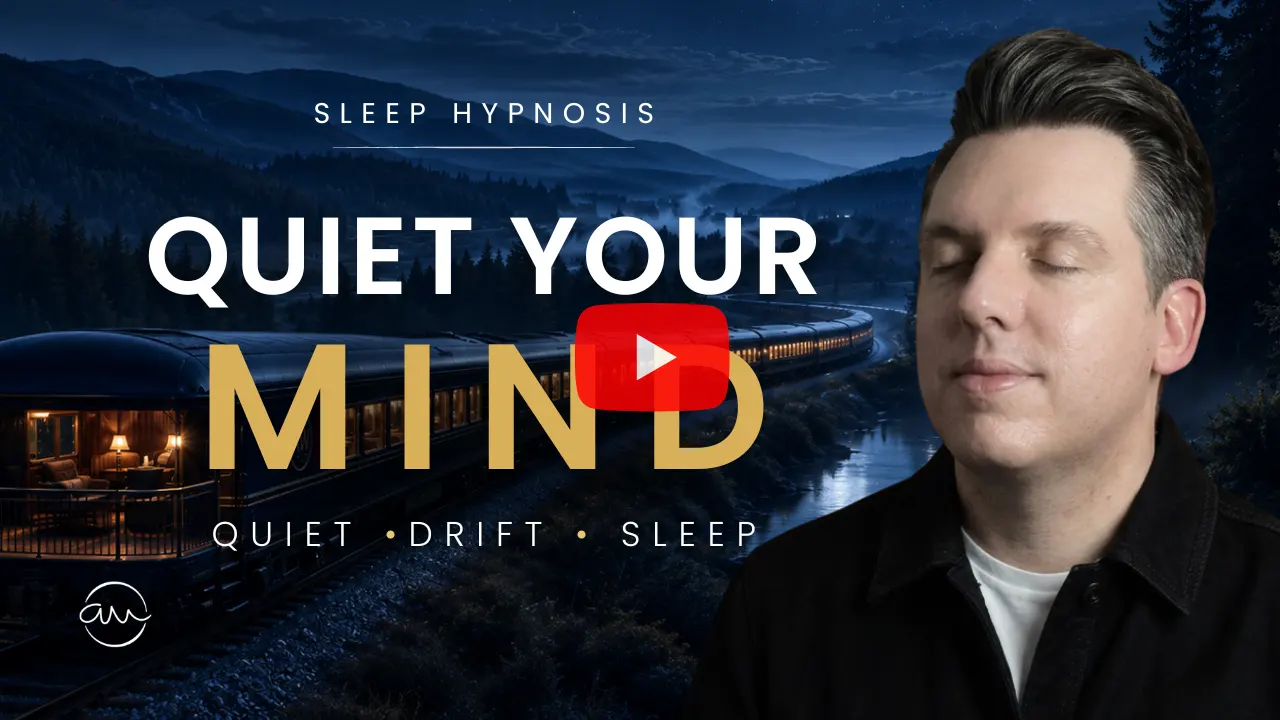
Recommended free sleep hypnosis on YouTube
Clinically guided sleep hypnosis
If you are choosing a sleep hypnosis recording on YouTube, it can be helpful to look for sessions created by someone with relevant therapeutic training, clear ethical standards, and an understanding of how suggestion, repetition, and nervous system settling work together.
As a clinical hypnotherapist and psychotherapist, I write my sleep hypnosis sessions with these principles in mind: gentle pacing, carefully chosen suggestions, repetition, and a clear focus on helping the mind drift away from effort rather than trying to force sleep.
These recordings are not a replacement for therapy, medical care, or personalised support. But they can be a helpful way to support relaxation, sleep readiness, and a calmer relationship with sleep as part of a healthy sleep routine.
You may want to start with one of these free guided sleep hypnosis sessions:
- Sleep hypnosis for overthinking
- Guided sleep hypnosis for anxiety
- Sleep hypnosis for waking in the night
- Deep sleep hypnosis with black screen
The REM sleep link most people miss
Sleep is not simply a passive state where the brain switches off completely.
The brain remains active through the night, cycling through different stages of sleep, including REM and non-REM sleep. NINDS explains that sleep affects almost every type of tissue and system in the body, including the brain, heart, lungs, metabolism, immune function, mood, and disease resistance.
From a hypnotherapy perspective, this matters because many people with stress, anxiety, or overthinking are not just struggling at bedtime. They may also be carrying a high level of emotional and mental load into the night.
That does not mean sleep hypnosis directly changes REM sleep in a simple or guaranteed way.
But it may support the conditions that help sleep unfold more naturally: less pressure, less arousal, less mental effort, and a calmer transition into rest.
In my clinical work, I often describe this as helping the mind stop rehearsing the day and begin moving towards a more settled state.
Sleep hypnosis is not about forcing the brain to sleep.
It is about helping the mind feel less required to stay on duty.
A final thought
The best free sleep hypnosis on YouTube is not necessarily the longest video, the most dramatic title, or the recording with the biggest promise.
It is the one that helps you feel safe enough to stop trying.
Sleep comes more easily when the mind no longer feels it has to monitor, solve, perform, or control everything.
That is why clinically informed sleep hypnosis focuses less on making something happen and more on helping effort begin to fade.
If you would like to experience this approach for yourself, you can explore my YouTube channel, where I share free guided sleep hypnosis sessions for overthinking, anxiety, night waking, and deep rest. Each session is created to help your mind step away from effort, settle more naturally, and build a calmer relationship with sleep.
On my channel, I also share therapist-led hypnosis and psychology videos around anxiety, sleep, confidence, procrastination, overthinking, and the connection between the gut, brain, and nervous system - all with the aim of helping you build a calmer, stronger mind through clinically informed hypnosis and practical psychology.
Suggested button text:
Explore free sleep hypnosis on YouTube
FAQ
What is the best sleep hypnosis on YouTube?
The best sleep hypnosis on YouTube is usually a recording that reduces mental effort, supports relaxation, uses careful suggestion, and helps attention drift rather than concentrate. Recordings created by a trained hypnotherapist or suitably qualified professional may offer an added layer of structure, safety, and ethical awareness.
Does sleep hypnosis actually work?
Sleep hypnosis can help some people relax, reduce mental arousal, and prepare for sleep. Research suggests hypnosis may benefit some sleep outcomes, although findings are mixed and more high-quality research is needed. It is best understood as a supportive tool rather than a guaranteed cure.
Is sleep hypnosis safe?
Gentle sleep hypnosis is generally safe for many people when used appropriately, but it is not suitable for every situation. If you have epilepsy, psychosis, severe trauma symptoms, dissociation, unstable mental health symptoms, or medical concerns affecting sleep or consciousness, speak to a qualified healthcare professional first.
Can YouTube sleep hypnosis replace therapy?
No. YouTube sleep hypnosis can support relaxation, sleep readiness, and calmer night-time routines, but it is not a replacement for therapy, medical care, diagnosis, or personalised mental health support. If sleep problems are persistent, severe, or linked to anxiety, trauma, depression, pain, or another health concern, speak to a qualified professional.
How do I know if a sleep hypnosis recording is safe?
Look for clear safety guidance, realistic claims, gentle language, and information about the creator’s professional background. Avoid recordings that make extreme promises, use frightening or emotionally intense imagery, or make you feel dependent on one specific recording.
Is sleep hypnosis better than meditation?
Sleep hypnosis and meditation can both be useful, but they work differently. Meditation often builds awareness and attention control, while sleep hypnosis may be more focused on reducing effort and encouraging drifting. Some people prefer meditation during the day and sleep hypnosis at night.
How often should I listen to sleep hypnosis?
Many people find sleep hypnosis more useful when they listen regularly rather than trying it once. Repetition can help the mind and body become more familiar with settling, drifting, and stepping away from effort.
Do I need to stay awake for sleep hypnosis to work?
Not necessarily. For sleep hypnosis, drifting in and out is usually part of the process. You do not need to remember every word or stay fully focused. The aim is to help attention soften, not to concentrate perfectly.
Can I listen to sleep hypnosis every night?
Many people listen to gentle sleep hypnosis regularly as part of a bedtime routine. However, if you feel dependent on it, distressed without it, or if your sleep problems are worsening, it may be helpful to speak with a qualified professional.
Important note: This article is for educational purposes only. Sleep hypnosis recordings can support relaxation, sleep readiness, and a calmer relationship with sleep, but they are not a replacement for therapy, medical care, diagnosis, or mental health treatment. If sleep problems are persistent, severe, worsening, or linked to anxiety, trauma, depression, medication, pain, breathing problems, or another health concern, speak to your GP or a suitably qualified healthcare professional.
References:
- Royal College of Psychiatrists - Hypnosis and hypnotherapy
- National Council for Hypnotherapy - Hypnotherapy FAQ
- AfSFH - Policies, professional standards, supervision and training
- NCH - Code of Ethical Conduct and Performance
- NHS - Herbal medicines and complementary therapies
- Hypnosis Intervention Effects on Sleep Outcomes: A Systematic Review
- Hypnotherapy for insomnia: systematic review and meta-analysis
- King’s College London - Modulating the default mode network using hypnosis
- Brain Activity and Functional Connectivity Associated with Hypnosis
- NINDS - Brain Basics